Conditions · Injuries
Whiplash
Whiplash-associated disorder describes symptoms that follow an acceleration-deceleration event involving the neck. People can report neck pain or stiffness, headache, upper-back or shoulder discomfort, dizziness, concentration problems, or symptoms traveling into an arm. Those complaints can overlap with concussion, fracture, nerve injury, and other conditions, so a webpage or symptom timeline cannot establish the diagnosis.
SpineCo treats whiplash within a dedicated auto injury pathway focused on safety screening, examination, documentation, individualized treatment planning, and coordination of care. It does not promise that early chiropractic treatment prevents chronic symptoms or that every post-collision complaint has one structural cause.
I was rear-ended in Downers Grove IL and my neck started hurting two days later—is that whiplash?
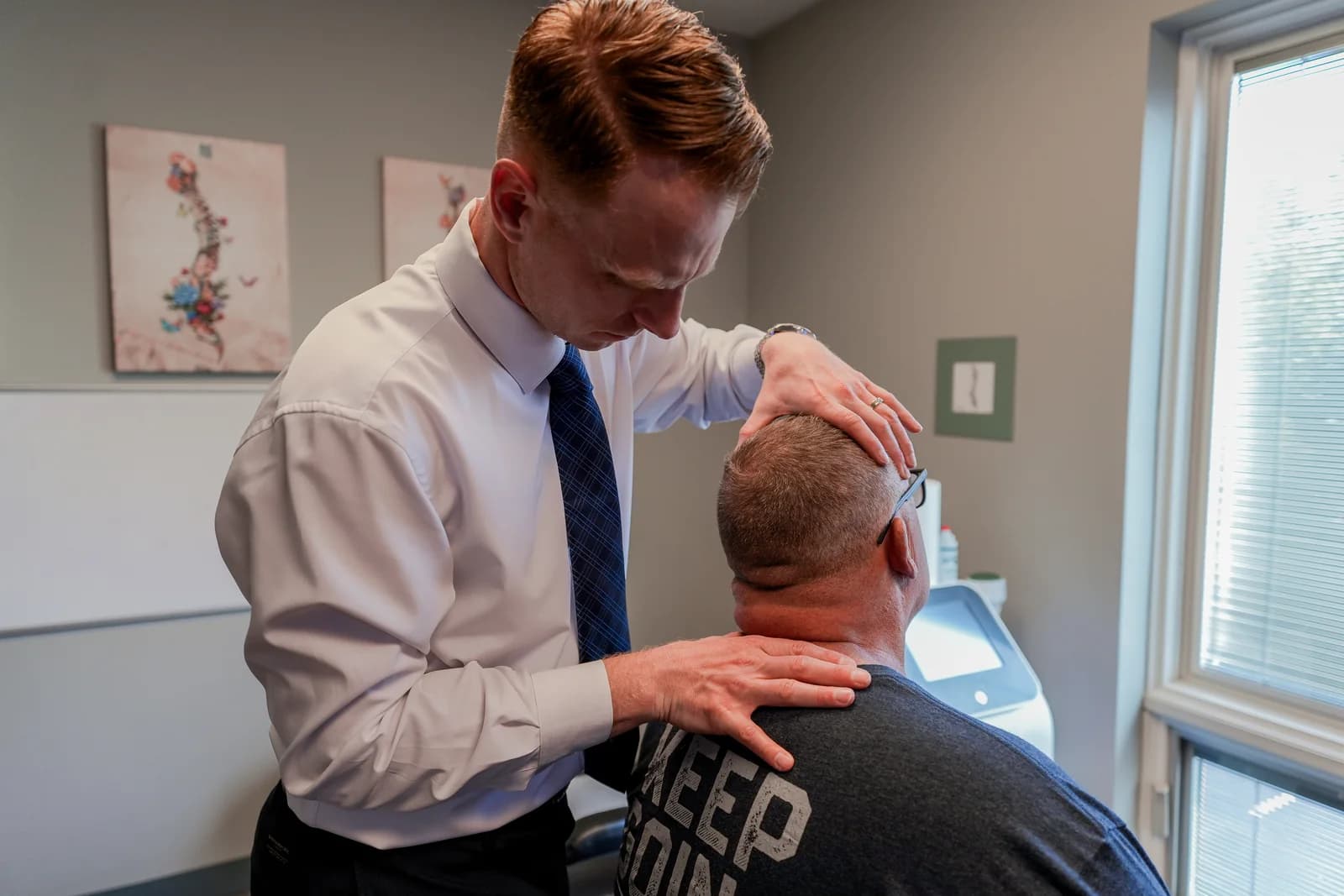
Neck pain, stiffness, headache, and other symptoms may be noticed immediately or later after a collision, but timing alone cannot confirm whiplash or identify an injured structure. At SpineCo in Downers Grove IL, Dr. Ryan Bielecki, D.C., reviews the collision and performs an appropriate examination to determine whether conservative care, imaging, medical evaluation, or referral is the right next step.
Symptoms and timing vary after a collision
A rapid change in speed can load the neck and surrounding tissues, but the collision description alone does not reveal which structures, if any, were injured. Symptoms may be present immediately, become more noticeable over hours or days, or change as normal activity resumes. Delayed awareness of symptoms is possible, but it is not proof of hidden structural damage or a specific mechanism.
The absence of pain at the scene does not rule out a later problem, and the later appearance of pain does not establish severity. A clinician considers the complete history, examination, neurological findings, and any other injuries rather than using a fixed 24- or 72-hour rule.
Call 911 or seek emergency care for loss of consciousness, increasing drowsiness, repeated vomiting, a worsening headache that does not go away, seizure, slurred speech, unusual confusion, unequal pupils, new weakness or numbness, or loss of coordination. Routine chiropractic care should not delay urgent trauma or head-injury assessment.
What a post-collision evaluation considers
Dr. Bielecki reviews how the collision occurred, when symptoms were noticed, prior injuries, relevant health history, care already received, and changes in sleep, work, driving, concentration, and daily activity. The physical examination is selected for the presentation and may include cervical and upper-back motion, muscle and joint findings, orthopedic procedures, strength, sensation, reflexes, and other neurological screening.
The examination cannot identify every tissue injury through palpation or range of motion alone. Findings are documented and interpreted together. If the history or examination raises concern for fracture, instability, significant neurological injury, concussion, vascular injury, or another condition outside SpineCo's scope, medical evaluation or referral takes priority.
Imaging is not automatic after every collision, and a chiropractic visit is not a substitute for emergency trauma assessment. Existing studies are reviewed when available. New imaging or referral is recommended when clinically indicated by the mechanism, examination, progressive findings, concern for serious injury, or whether the result would change management.
Individualized care without an early-treatment guarantee
Whiplash guidelines do not establish a deadline after which symptoms become permanently fixed, and timing alone cannot guarantee that treatment will prevent persistent symptoms. An evaluation can still be useful when symptoms are new, changing, or interfering with normal activity because it helps identify safety concerns and establishes a plan based on the current presentation.
When conservative care is appropriate, a plan may combine education, activity guidance, manual or chiropractic care, progressive range-of-motion work, and exercise. Clinical guidelines support multimodal care for selected whiplash-associated disorders, but the combination, timing, and intensity should be adjusted to the patient's findings and response.
Progress is tracked through pain, motion, neurological findings, sleep, driving, work, and other meaningful activities. Dr. Bielecki can continue, modify, pause, or refer based on that response rather than promising a fixed visit count, recovery date, or durable outcome.
Headache, dizziness, and arm symptoms need differential assessment
Headache, dizziness, concentration difficulty, sleep disturbance, arm pain, tingling, or numbness can occur after a collision, but none automatically identifies a cervical joint, disc, muscle, or nerve as the source. Headache and cognitive or balance symptoms can also overlap with concussion and other medical conditions.
SpineCo screens for findings that change the care path and refers when medical or emergency assessment is more appropriate. A normal acute-care examination or normal imaging can be reassuring for the conditions evaluated, but it does not mean that every symptom must be ignored. New, worsening, or persistent concerns should be discussed with an appropriate healthcare professional.
Getting evaluated in Downers Grove
A first visit documents the collision and symptom history, relevant examination findings, functional changes, and recommended next steps. The recommendation may be conservative care, monitoring, imaging, coordination with another provider, or referral. SpineCo does not determine fault or guarantee an insurance or legal outcome.
SpineCo is located at 1121 Warren Ave Suite 210, Downers Grove, IL 60515. Book online through the Jane App or call (630) 442-0146. Office hours: Monday, Wednesday, and Thursday 9am–6pm; Tuesday 2pm–7pm; Friday 9am–2pm; Saturday and Sunday closed.
Identify the problem. Build the right plan. Return to what matters.
Schedule an evaluation online, or call the office and talk it through first.
FAQ
Questions, answered.
My neck didn't hurt right after the accident. Can I still have whiplash?
Symptoms associated with a collision can be noticed immediately or later, but delayed onset alone does not confirm whiplash, identify an injured structure, or establish severity. Seek emergency care for head-injury danger signs, new neurological deficits, severe or worsening symptoms, or major trauma. For non-emergency concerns, an examination can help determine the appropriate next step.
How is whiplash different from general neck strain?
Whiplash-associated disorder refers to a range of symptoms following an acceleration-deceleration event, while neck strain is a more general soft-tissue diagnosis. The terms can overlap, and symptoms can involve more than muscle tissue. History, examination, safety screening, and imaging when clinically indicated are needed before assigning a diagnosis or plan.
How long does whiplash take to improve with conservative care?
Recovery varies and cannot be predicted from the collision timing alone. Symptom severity, neurological findings, other injuries, health history, activity demands, psychosocial factors, and response to care can all influence progress. SpineCo reassesses meaningful function and refers when symptoms worsen, new findings appear, or progress does not fit the expected clinical course.
Can whiplash cause headaches?
Headaches can occur after a collision, but the neck is not the only possible source. Concussion and other medical conditions can cause overlapping symptoms. A worsening headache that does not go away, repeated vomiting, unusual confusion, increasing drowsiness, seizure, slurred speech, unequal pupils, or new weakness or loss of coordination requires emergency medical care.
Urgent care said everything was normal. Should I still be evaluated?
An acute-care evaluation is designed to identify the urgent conditions considered at that visit, and normal results can be reassuring. If non-emergency neck, back, headache, or movement concerns persist or change, follow-up with an appropriate healthcare professional can clarify management. Return to urgent or emergency care for new danger signs or rapidly worsening symptoms.
How do I book a whiplash evaluation at SpineCo in Downers Grove?
Book online through the Jane App at SpineCo's booking page or call (630) 442-0146. SpineCo is at 1121 Warren Ave Suite 210, Downers Grove, IL 60515. Hours: Mon/Wed/Thu 9am–6pm, Tue 2pm–7pm, Fri 9am–2pm, Sat/Sun closed.
Clinical references
Sources used on this page
- Symptoms of Mild TBI and Concussion — Centers for Disease Control and Prevention
- ACR Appropriateness Criteria: Acute Spinal Trauma — American College of Radiology
- The Treatment of Neck Pain-Associated Disorders and Whiplash-Associated Disorders: A Clinical Practice Guideline — Journal of Manipulative and Physiological Therapeutics via PubMed
Related care