Conditions · Extremities
Knee Pain
The knee is one of the most frequently blamed joints in the body — and one of the most frequently misunderstood. Knee pain in Downers Grove IL is common, but the knee is often the location of the symptom rather than the source of the problem. Restrictions in the hip, compensation patterns from the ankle, or dysfunction in the pelvis can all concentrate mechanical stress on the knee joint, producing pain even when the knee itself has no structural damage.
Dr. Ryan Bielecki, D.C., knows this dynamic from personal experience. Recurring knee pain during his collegiate baseball career was eventually traced not to the knee, but to functional deficits in his pelvis and spine that were silently overloading the joint. That finding — and the resolution that followed through chiropractic care — is a direct influence on how SpineCo approaches every knee case today.
Can a chiropractor help with knee pain in Downers Grove IL?
Yes. At SpineCo: Chiropractic & Performance in Downers Grove IL, Dr. Ryan Bielecki, D.C., evaluates knee pain by examining the full kinetic chain — pelvis, hip, and ankle — because the knee frequently absorbs excess load due to restrictions elsewhere. Identifying those upstream contributors often changes what treatment is needed.
The knee as messenger: reading what the chain is telling you
In a well-functioning kinetic chain, load transfers evenly from the foot through the ankle, knee, hip, and pelvis during movement. When any segment in that chain loses mobility or stability, the knee — as the middle link — is particularly vulnerable to absorbing compensatory stress. This is why two people with identical MRI findings can have very different functional outcomes, and why treating the knee in isolation often produces incomplete results.
Hip mobility restrictions change the way the femur tracks during walking, running, and squatting — directly altering mechanical load at the medial or lateral knee. Ankle dorsiflexion limitations force altered mechanics upstream. Pelvic asymmetry changes the angle at which each leg contacts the ground with every step. Dr. Bielecki's examination process at SpineCo accounts for all of these contributors before a treatment plan is developed.
This is not to say the knee itself is never the primary problem. Acute ligament injuries, meniscal pathology, and cartilage conditions require accurate diagnosis, and SpineCo uses orthopedic testing and clinical history to determine what is structural versus what may be addressed with chiropractic care, active rehabilitation, or referral.
Conditions that commonly contribute to knee pain
Patellofemoral syndrome — pain behind or around the kneecap — is among the most prevalent complaints seen in active adults and athletes. It is frequently driven by hip weakness or tightness, altered patellar tracking, and foot mechanics, making a kinetic chain approach directly relevant.
IT band syndrome is another condition that often presents as lateral knee pain but is rooted in hip abductor function and pelvic stability during single-leg loading. Addressing only the ITB tissue itself — without correcting the mechanics that generated the load — is a common reason this condition recurs in runners and cyclists.
Medial and lateral compartment pain, bursitis, and early osteoarthritic symptoms can all be influenced by how mechanical load is distributed across the knee. Chiropractic care, movement guidance, and active rehabilitation at SpineCo focus on restoring more balanced loading patterns.
Why Dr. Bielecki's own knee history matters to your care
During his collegiate baseball career, Dr. Bielecki experienced recurring knee pain that was attributed to the knee itself — and addressed there, with predictable results: temporary improvement followed by recurrence. It was through chiropractic evaluation that the actual driver was identified: his spine and pelvis were not moving efficiently, and the knee was bearing a disproportionate share of the load every time he pushed off, pivoted, or landed.
Once those upstream deficits were corrected, the knee pain resolved — and stayed resolved. This experience is not incidental background; it directly shapes how Dr. Bielecki examines and explains knee cases to every patient at SpineCo. The knee is always evaluated in the context of the joints above and below it.
Training five to six times per week, Dr. Bielecki maintains the functional demands of an active adult. He understands that knee pain is not just discomfort — it is a threat to training, performance, and the quality of daily life. The goal at SpineCo is to identify the real source and address it, not to manage the symptom indefinitely.
What an evaluation and plan looks like at SpineCo
Every knee pain evaluation begins with a complete history — onset, mechanism, aggravating and relieving factors, prior injuries, and activity levels. Dr. Bielecki then performs a physical examination that includes the knee joint, hip mobility, ankle dorsiflexion, and pelvic alignment. Orthopedic tests help differentiate ligamentous, meniscal, and mechanical contributions.
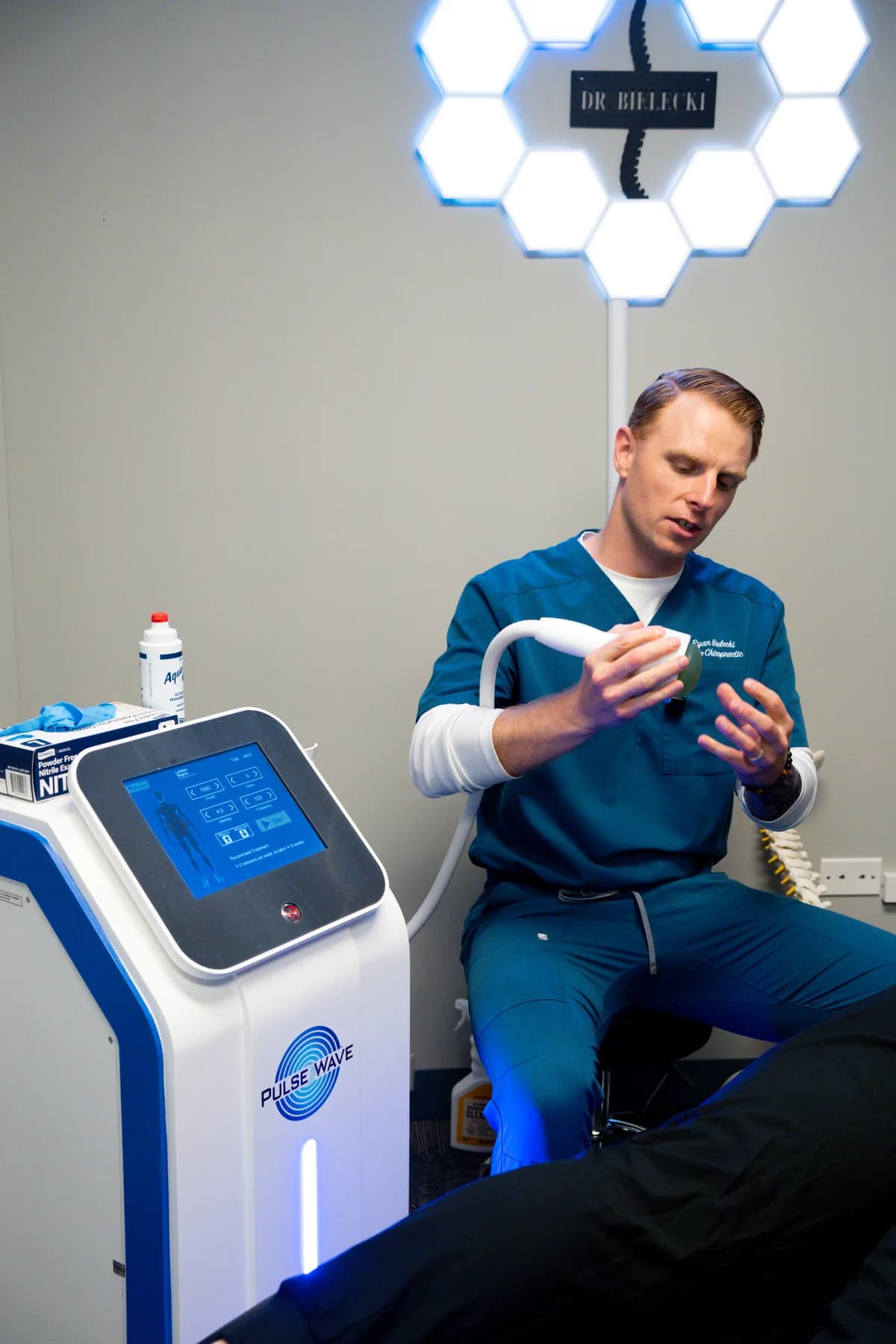
Treatment is matched to findings. For patients whose knee pain has a clear mechanical and kinetic chain origin, chiropractic adjustments to the spine and pelvis — combined with joint mobilization and targeted exercise — often produce meaningful improvement. For patients whose presentation includes soft-tissue components, shockwave therapy and physical rehabilitation are available at SpineCo as part of a coordinated plan. There is no risk to see what we can do for you.
There is no risk to see what we can do for you.
Book online in under a minute, or call the office and talk it through first.
FAQ
Questions, answered.
Can a chiropractor treat knee pain, or is that only for back problems?
Chiropractic care addresses the musculoskeletal system broadly, including extremity joints. At SpineCo, Dr. Bielecki evaluates and treats knee pain both directly — through joint mobilization — and indirectly by correcting spinal and pelvic mechanics that may be overloading the knee. Many patients find that combining both approaches produces better outcomes than treating the knee in isolation.
My knee pain started gradually with no obvious injury. Should I still see a chiropractor?
Gradual-onset knee pain is often mechanical in origin — the result of accumulated load imbalances rather than a single traumatic event. This pattern is exactly where kinetic chain assessment tends to be most revealing. SpineCo evaluates hip mobility, pelvic alignment, ankle function, and spinal mechanics to identify what may be contributing to your symptoms.
I've had knee pain for years. Is it too late for chiropractic care to help?
Chronic knee pain can have multiple contributors, and some mechanical contributors may respond to chiropractic care, movement guidance, or shockwave therapy. A thorough evaluation at SpineCo determines which aspects of your knee pain are addressable versus structural and may require referral.
Does Dr. Bielecki treat knee pain in young athletes and kids?
Yes. SpineCo works with young athletes, including youth and high school competitors, for knee pain conditions such as Osgood-Schlatter, patellofemoral syndrome, and sports-related strains. Children and adolescents are welcome at SpineCo alongside adult and older patients.
How do I schedule a knee pain evaluation in Downers Grove IL?
Book online through the Jane App or call (630) 442-0146. SpineCo is at 1121 Warren Ave Suite 210, Downers Grove, IL 60515. Hours: Monday, Wednesday, and Thursday 9am–6pm; Tuesday 2pm–7pm; Friday 9am–2pm; Saturday and Sunday closed.
Related care