The Services
Focused Shockwave Therapy
Advanced conservative treatment for stubborn orthopedic and soft-tissue injuries. That is the role focused shockwave therapy serves at SpineCo - not a generic sports-recovery add-on, and not a treatment applied simply because an area hurts.
Persistent heel, tendon, elbow, knee, or other soft-tissue pain can have several possible drivers. Dr. Bielecki first identifies the likely tissue source, checks the surrounding joints and movement pattern, and screens for findings that need another type of care. Shockwave is considered only when the examination and treatment goal fit the technology.
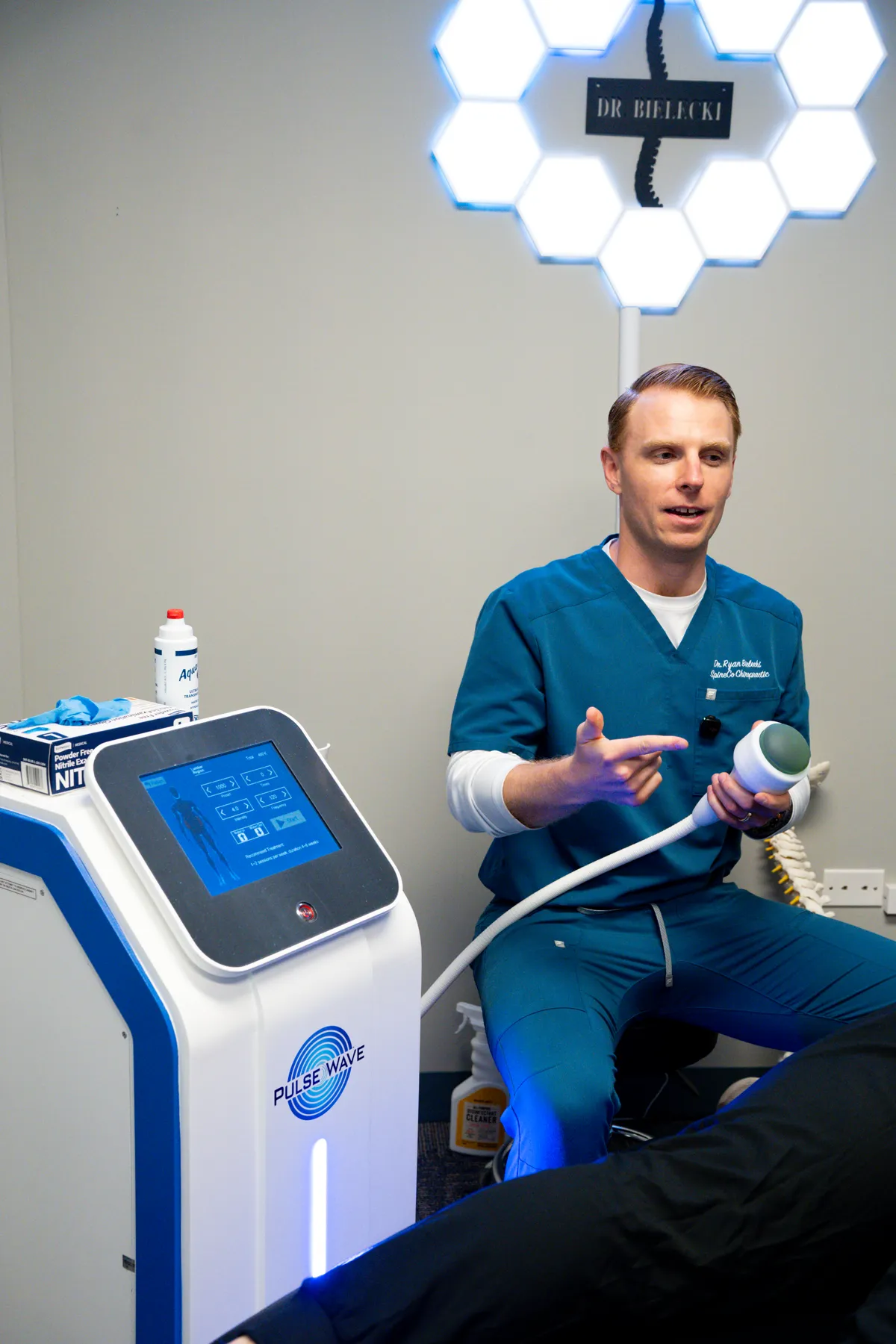
What is focused shockwave therapy for orthopedic and soft-tissue injuries?
Focused shockwave therapy is a non-invasive treatment that delivers acoustic pressure waves to a selected tissue target. At SpineCo, Dr. Ryan Bielecki may consider it for certain persistent orthopedic or tendon-related problems after an examination. Evidence and response vary by condition, so it is used within a broader plan rather than promised as a standalone fix.
Assessment separates a tissue target from referred pain
Pain over a tendon or muscle does not always mean that tissue is the only source. Symptoms can be influenced by a nearby joint, nerve irritation, a change in workload, an acute injury, or referred pain from the spine. Treating the painful spot without examining the region can miss the problem that is actually limiting recovery.
Dr. Bielecki reviews when the symptoms began, what loads aggravate them, what care has already been tried, and how the problem affects work and normal activity. The examination may include motion, strength, tendon loading, neurological or orthopedic tests, and screening of related regions. Imaging or referral is considered when clinically indicated.
How focused shockwave therapy is applied
Extracorporeal shockwave therapy uses a device to pass acoustic pressure waves through the skin to a defined treatment area. The tissue target, device settings, and number of applications are selected for the individual presentation. Dr. Bielecki monitors comfort and response rather than applying the same protocol to every patient.
The exact biological mechanism by which shockwave may affect tendinopathy is not fully established. It should not be described as rebuilding tissue, regenerating nerves, breaking up every calcification, or guaranteeing healing. The clinically useful question is whether a carefully selected patient shows meaningful improvement in pain, function, and load tolerance over time.
Selected stubborn conditions may be considered
Shockwave may be discussed for selected persistent conditions such as plantar fasciitis, Achilles tendinopathy, tennis elbow, and other tendon or soft-tissue presentations that have not improved as expected with an appropriate first-line plan. A diagnosis and chronicity matter; evidence from one body region cannot automatically be generalized to every painful tendon or joint.
Clinical guidance also reflects uncertainty. Studies and treatment protocols differ, and evidence of benefit is inconsistent for some conditions. SpineCo explains that limitation before treatment. A patient should understand why shockwave is being considered, what alternatives remain available, what progress will be measured, and when the plan should be changed.
What to expect and how safety is screened
Treatment is delivered through the skin over the selected area and can cause temporary discomfort. Reported effects can include soreness, skin redness, bruising, swelling, or temporary numbness. Health history, medications, the condition of the treatment area, and other relevant precautions are reviewed before a session is scheduled.
There is no universal three-visit, six-visit, or recovery timeline. Frequency and total sessions depend on the condition, device protocol, symptom response, and functional change. If symptoms worsen, expected progress does not occur, or the clinical picture changes, Dr. Bielecki reassesses rather than continuing a preset package.
Shockwave works within a complete care plan
For many orthopedic and tendon-related problems, restoring capacity also involves progressive exercise, activity or workload changes, and attention to the joints and movement patterns surrounding the painful tissue. Shockwave may support that plan for a selected patient, but it does not replace active rehabilitation or an appropriate referral.
Progress is tied to the patient's real goal: walking, standing, gripping, lifting, working, climbing stairs, or returning to another normal activity with better tolerance. That condition-first approach keeps the technology in its proper role - a focused conservative option for an appropriate case, not the definition of the patient's care.
Identify the problem. Build the right plan. Return to what matters.
Schedule an evaluation online, or call the office and talk it through first.
FAQ
Questions, answered.
Which conditions may be considered for focused shockwave therapy?
Dr. Bielecki may consider shockwave for selected persistent orthopedic or soft-tissue problems such as plantar fasciitis, Achilles tendinopathy, tennis elbow, and some other tendon-related presentations. The painful area, diagnosis, symptom duration, prior care, health history, and examination all matter; the treatment is not assumed appropriate from a symptom name alone.
Does focused shockwave therapy guarantee that an injury will heal?
No. Evidence and response vary by condition, patient selection, and treatment protocol. Shockwave should not be presented as a cure or a replacement for diagnosis, exercise, or referral. SpineCo uses it selectively, explains the uncertainty, and measures whether the individual patient is making meaningful functional progress.
Is shockwave therapy painful or risk-free?
Treatment can be uncomfortable, and temporary soreness, redness, bruising, swelling, or numbness may occur. Dr. Bielecki screens health history and the treatment area, adjusts the application when appropriate, and explains relevant risks before care. No medical procedure should be described as completely risk-free.
How many focused shockwave sessions will I need?
There is no universal course. The recommendation depends on the condition, how long symptoms have been present, the device protocol, and the patient's response. Dr. Bielecki outlines an initial plan after the examination and reassesses pain, function, and load tolerance instead of promising improvement on a fixed timeline.
Is shockwave therapy used by itself?
Usually it is considered as one part of a broader conservative plan. Depending on the findings, that plan may also include progressive exercise, activity modification, chiropractic or manual care, and guidance for returning to normal work or daily activity. Referral is appropriate when the problem needs care outside SpineCo's scope.
How do I schedule a shockwave evaluation at SpineCo?
Book online through Jane App or call (630) 442-0146. SpineCo is at 1121 Warren Ave Suite 210, Downers Grove, IL 60515. Office hours are Monday, Wednesday, and Thursday 9am-6pm; Tuesday 2pm-7pm; Friday 9am-2pm; Saturday and Sunday closed.
Clinical references
Sources used on this page
- Extracorporeal shockwave therapy for refractory plantar fasciitis — National Institute for Health and Care Excellence
- Extracorporeal shockwave therapy for Achilles tendinopathy — National Institute for Health and Care Excellence
- Extracorporeal shockwave therapy for refractory tennis elbow — National Institute for Health and Care Excellence
- Plantar Fasciitis and Bone Spurs — American Academy of Orthopaedic Surgeons