Conditions · Extremities
Arm & Leg Pain
Arm pain and leg pain in Downers Grove IL are often treated where they appear — at the elbow, the wrist, the knee, the calf. But the nervous system does not respect those anatomical boundaries. The nerves supplying sensation and motor function to the arms and legs originate at the spinal cord, travel through the cervical and lumbar spine, and extend all the way to the fingertips and toes. An irritation anywhere along that pathway can produce symptoms at any point downstream.
At SpineCo: Chiropractic & Performance, Dr. Ryan Bielecki, D.C., approaches arm and leg pain as a pathway problem before assuming it is a local joint problem. That distinction — identifying where along the neural chain the irritation actually lives — determines whether treatment at the spine, the limb, or both is warranted. It is a fundamentally different clinical question than 'what hurts and where.'
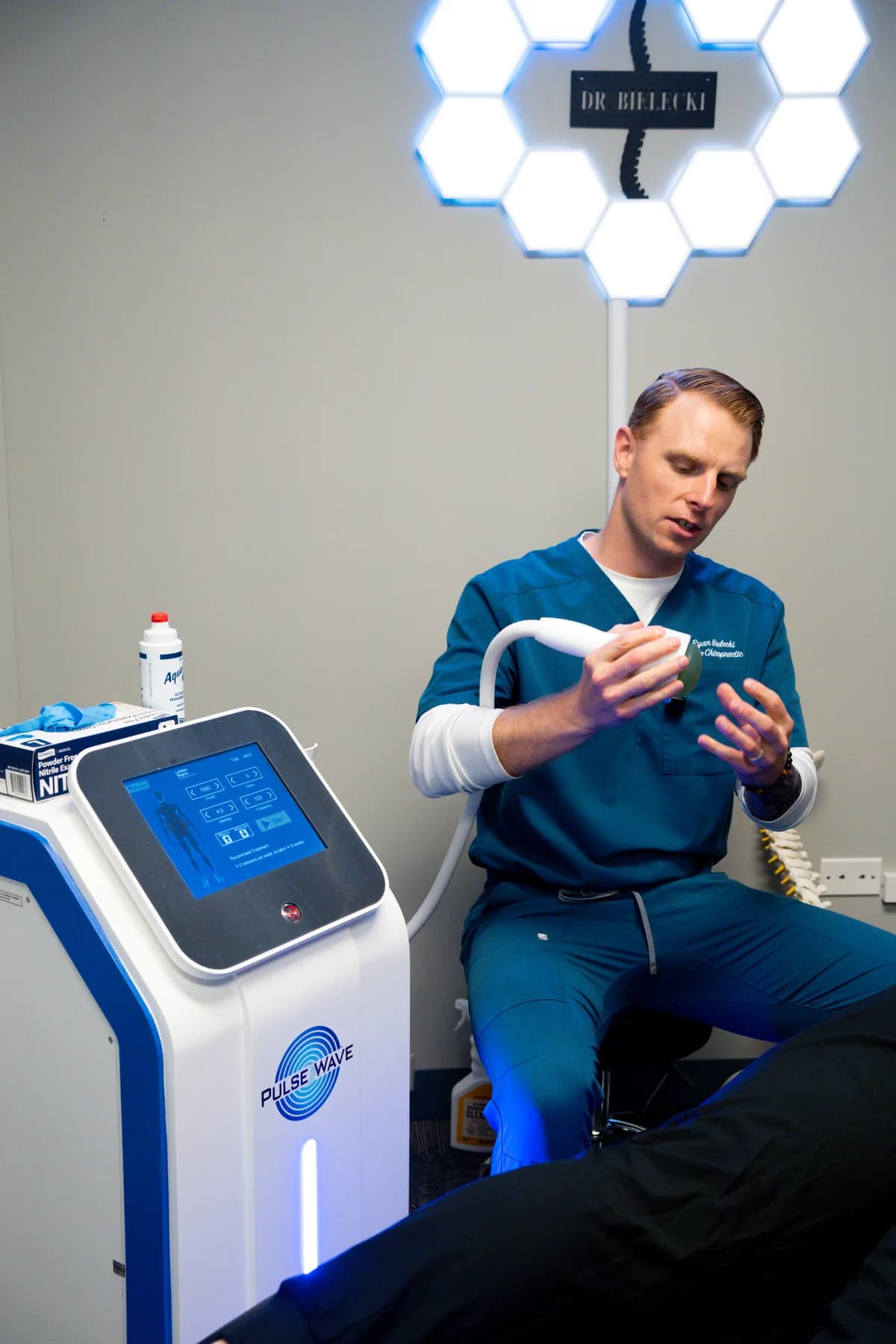
Can arm or leg pain in Downers Grove IL be caused by a spinal problem?
Yes — frequently. At SpineCo: Chiropractic & Performance in Downers Grove IL, Dr. Ryan Bielecki, D.C., evaluates arm and leg pain by tracing the neural pathway from the limb back to the spine. Many patients experiencing pain, numbness, or tingling in an arm or leg have a spinal origin that, when addressed, changes the entire picture.
Radiating versus referred pain: understanding the difference
Radiating pain follows the course of a specific nerve. Sciatica is the most familiar example: a nerve root irritated in the lumbar spine produces pain, tingling, or numbness that travels through the buttock and down the back of the leg along a predictable path. The same mechanism operates in the cervical spine, where a compressed or irritated nerve root may produce arm pain, hand numbness, or shoulder blade discomfort along a dermatomal pattern.
Referred pain is anatomically distinct but commonly confused with radiating pain. Rather than following a nerve pathway, referred pain is perceived at a location distant from the actual tissue generating the signal — hip joint pathology may refer to the lateral thigh, sacroiliac dysfunction to the posterior leg, and facet joint irritation to various regions of the extremity without a dermatomal pattern. Both mechanisms can produce limb pain that has no local structural cause.
Distinguishing between these two types of pain matters clinically. A patient with leg pain from a lumbar disc herniation needs a different treatment approach than one with referred pain from a dysfunctional sacroiliac joint. SpineCo's evaluation process is designed to identify which mechanism is operating before any treatment is applied.
Spinal sources of arm pain
Cervical nerve root irritation — whether from a disc bulge, foraminal narrowing, or segmental dysfunction — is a primary generator of arm pain, hand tingling, and grip weakness. The C5 through C8 nerve roots each supply distinct regions of the arm and hand; knowing the distribution of symptoms helps localize the spinal level involved.
Thoracic outlet contributions, scalene muscle tightness, and first-rib restrictions can compress the brachial plexus between the neck and the arm, producing symptoms that feel indistinguishable from a primary arm or shoulder condition. These cases are routinely missed when evaluation begins at the arm rather than the cervical spine.
At SpineCo, cervical evaluation — range of motion, segmental mobility testing, orthopedic provocation tests — is the starting point for any patient presenting with arm pain, hand numbness, or tingling. Restoring spinal mobility at the source often relieves symptoms in the arm without any direct arm treatment being necessary.
Spinal sources of leg pain
Lumbar nerve root irritation is the most common spinal origin of leg symptoms. The lumbar spine, particularly the L4–S1 levels, houses the nerve roots that form the sciatic nerve and supply the muscles and skin of the leg and foot. Disc herniation, facet arthropathy, and segmental hypomobility at these levels all have the potential to generate pain, numbness, or weakness that travels into the leg — sometimes to the calf or foot — with little or no back pain accompanying it.
This is one of the most clinically significant points in arm and leg pain assessment: the patient who presents with isolated leg pain and insists their back feels fine may still have a spinal source for those symptoms. Nerve irritation at the spine does not always produce local back pain. The leg may be the only symptomatic region.
SpineCo evaluates the lumbar spine, pelvis, and sacroiliac joints for all patients with leg pain, regardless of whether back pain is reported. This approach ensures that spinal contributions are identified and addressed rather than inadvertently bypassed because the patient's attention — and prior treatment — was directed entirely at the limb.
Tracing the pathway changes the treatment
When arm or leg pain is traced to a spinal origin, chiropractic adjustments that restore normal mobility to the affected spinal segments often relieve limb symptoms that local treatment failed to resolve. This is not a theoretical effect — it reflects the direct mechanical and neurological relationship between spinal joint function and peripheral nerve health.
Some patients require care at both the spine and the limb. A patient with a lumbar nerve root irritation and a secondary ankle restriction, for example, benefits from addressing both levels. SpineCo's evaluation identifies which components are driving the presentation and sequences the treatment accordingly.
For patients with chronic arm or leg pain that has not responded to prior conservative care, the evaluation at SpineCo often identifies spinal contributors that were not examined previously. A focused evaluation can clarify whether care at SpineCo is appropriate or whether imaging or referral should come first.
Identify the problem. Build the right plan. Return to what matters.
Schedule an evaluation online, or call the office and talk it through first.
FAQ
Questions, answered.
My arm hurts but my neck feels fine. Could the source still be in my spine?
Yes. Nerve root irritation in the cervical spine can produce arm pain, numbness, or tingling without generating noticeable neck pain. The nerve's irritation point and its symptomatic expression along the arm are different locations. SpineCo evaluates the cervical spine for all arm pain presentations regardless of whether neck symptoms are reported.
How do I know if my leg pain is sciatica or something else?
Sciatica is a specific pattern — nerve root irritation in the lumbar spine producing pain, numbness, or tingling along the course of the sciatic nerve into the buttock and leg. Other leg pain patterns may involve referred pain from the sacroiliac joint, hip, or lumbar facets, or local conditions in the leg itself. Dr. Bielecki's evaluation at SpineCo differentiates these mechanisms to direct treatment appropriately.
Can chiropractic care relieve numbness and tingling in the hands or feet?
When numbness or tingling in the hands or feet originates from spinal nerve root irritation or compression, chiropractic adjustments that reduce that irritation often help relieve those sensations. Carpal tunnel syndrome, tarsal tunnel syndrome, and other peripheral entrapments may also contribute and can be evaluated simultaneously at SpineCo.
I've had arm and leg pain for months and tried physical therapy without lasting improvement. Is chiropractic worth trying?
Long-standing arm and leg pain that has not fully resolved with prior treatment is often the result of a spinal component that was not adequately addressed. SpineCo evaluates the entire pathway — from the spine through the limb — and builds a treatment plan around what the examination actually shows. Many patients with chronic presentations find that this broader evaluation reveals something previously overlooked.
How do I book an evaluation for arm or leg pain in Downers Grove IL?
Schedule online through the Jane App or call SpineCo at (630) 442-0146. The clinic is located at 1121 Warren Ave Suite 210, Downers Grove, IL 60515. Office hours: Monday, Wednesday, and Thursday 9am–6pm; Tuesday 2pm–7pm; Friday 9am–2pm; Saturday and Sunday closed.
Related care