Conditions · Spine
Neck Pain
Neck pain can involve stiffness, restricted movement, or discomfort that travels toward a shoulder or arm. At SpineCo in Downers Grove, IL, care starts with a one-on-one assessment by Dr. Ryan Bielecki, D.C., to determine whether conservative treatment, imaging, or referral is appropriate.
Pain after desk work, a restless night, or a collision does not establish a diagnosis by itself. The pattern, duration, associated symptoms, and examination help distinguish local discomfort from a nerve problem or another condition. An adjustment is one possible option, not an automatic next step.
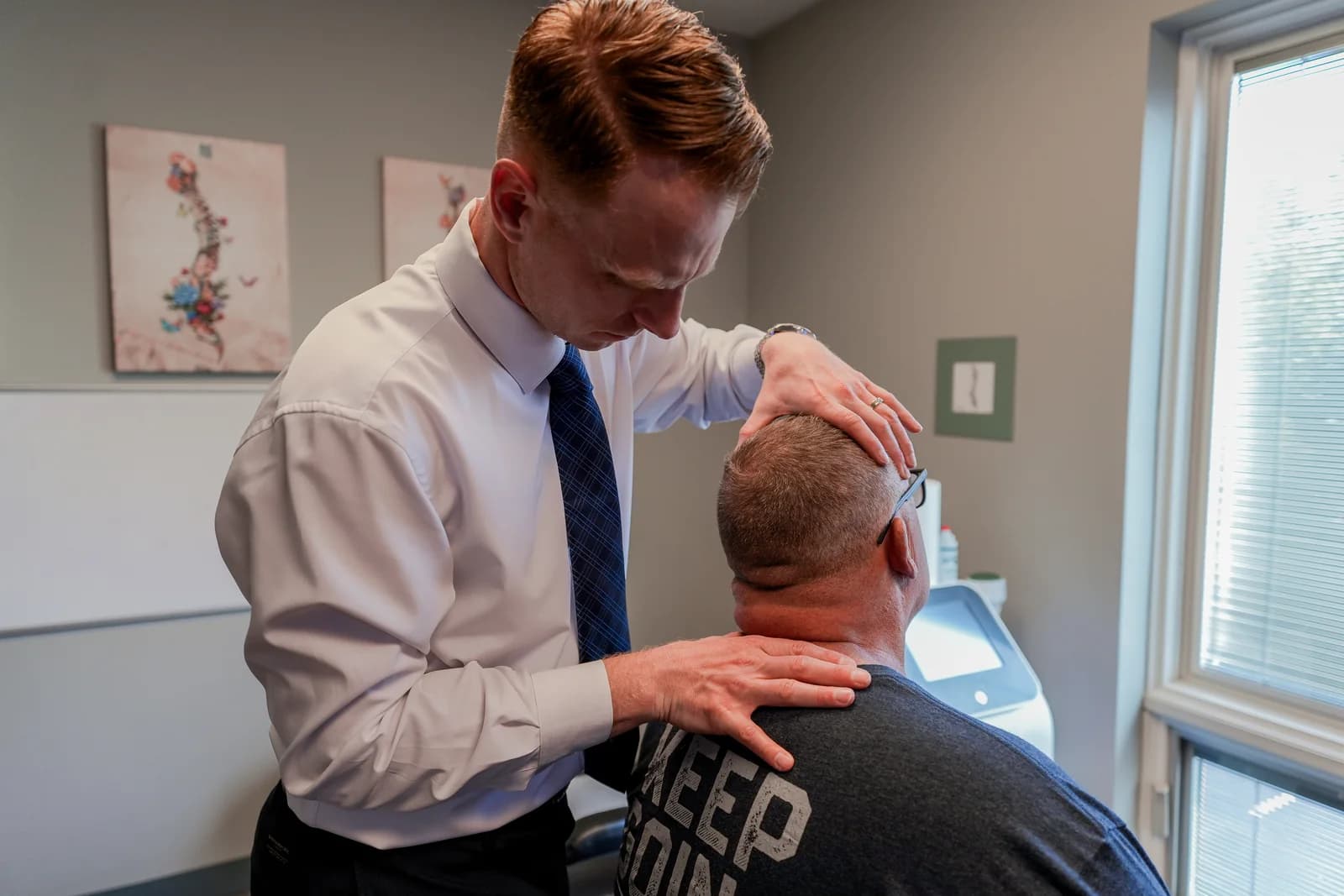
Can a chiropractor in Downers Grove help with neck pain?
Chiropractic care may be an option for some neck pain after an examination establishes that conservative care is appropriate. At SpineCo in Downers Grove, Dr. Ryan Bielecki, D.C., evaluates movement, strength, sensation, and the history of symptoms. New weakness, significant injury, or other warning signs can require medical evaluation first.
What can cause neck pain, and what do arm symptoms mean?
The neck contains joints, discs, muscles, and nerves that can contribute to symptoms. Sustained positions or an injury may make the area uncomfortable, but a posture photograph cannot identify the painful tissue. Looking down at a screen does not, by itself, establish disc damage or a need for repeated treatment.
Cervical radiculopathy means irritation or compression of a nerve root in the neck. It can produce pain that travels into an arm, tingling, altered sensation, or weakness. The American Academy of Orthopaedic Surgeons explains that disc changes or narrowing around a nerve can be involved, but degenerative changes also occur in people without symptoms.
A sore neck and a headache may occur together without sharing the same cause. Tell the clinician whether a headache is familiar or new, whether arm symptoms are spreading, and whether balance, coordination, or strength has changed. Those details can change the urgency and the type of assessment needed.
When should neck pain receive urgent medical attention?
Call 911 for sudden facial drooping, arm weakness, trouble speaking, a sudden severe headache, or sudden loss of balance or vision. These can be stroke warning signs. Neck, jaw, or arm discomfort with chest pressure, shortness of breath, or sweating also needs emergency attention. Do not wait for a chiropractic appointment.
Get emergency medical help now for neck stiffness with fever and a severe headache. Seek urgent medical assessment after a significant neck injury, or for new difficulty walking, loss of bladder or bowel control, or rapidly worsening weakness. MedlinePlus and the American Heart Association describe warning signs that require medical care rather than routine self-care.
Persistent numbness, symptoms in both arms, or a change in hand coordination should be reported promptly even when pain is mild. Tell the clinician about cancer, recent infection, osteoporosis, surgery, and medications. This page cannot determine whether your symptoms are safe to manage at home.
What happens during a one-on-one neck evaluation at SpineCo?
Dr. Bielecki begins with the history: when symptoms started, whether there was an injury, where discomfort travels, and which activities make it better or worse. Bring existing imaging reports if you have them and a current medication list. Describe limitations that matter to you, such as checking traffic, working at a desk, sleeping, or using an arm.
The examination considers neck movement alongside relevant orthopedic and neurological findings. Strength, sensation, reflexes, and the shoulder or upper back can help clarify the presentation. No single posture finding or movement test should be treated as proof of the cause; the findings need to make sense together.
The purpose is to explain the options and whether the presentation fits SpineCo's scope of care. Care is delivered one-on-one with Dr. Bielecki. You can ask what a proposed treatment is intended to do, what alternatives exist, and which changes would make additional evaluation necessary.
Do neck pain or a pinched nerve always need imaging?
Imaging decisions depend on the symptoms and examination. The American College of Radiology separates uncomplicated neck pain from presentations involving trauma, suspected infection or cancer, previous surgery, or nerve-root symptoms. An MRI is not automatically the first test for every painful or stiff neck.
An X-ray and an MRI answer different questions. Imaging findings also need to be interpreted alongside symptoms: a change on a scan may not explain the pain. Ask what the proposed study would clarify and how its result could change treatment or referral. Progressive neurological findings can change that decision.
What treatment options and limitations should you discuss?
For a presentation appropriate for conservative care, options at SpineCo may include chiropractic care, soft-tissue work, and movement guidance selected from the evaluation. A plan should address the activities that are limited and explain how progress will be assessed. A treatment recommendation should not depend only on the name of a condition.
The National Center for Complementary and Integrative Health reports that manipulation or mobilization may help some neck pain, while noting limitations and inconsistent results in the research. That evidence does not establish that every patient needs manipulation or will improve immediately. Ask about expected benefits, alternatives, and relevant risks before proceeding.
Temporary soreness, stiffness, or increased discomfort can follow manual treatment. Serious neurological problems and strokes have also been reported; NCCIH notes that these events are rare and reliable frequency estimates are unavailable. Share your medical history, ask how it affects suitability, and seek emergency care for new warning signs.
How do you plan the next step for neck pain in Downers Grove?
An appointment is an opportunity to clarify the findings and discuss options. You do not need to diagnose yourself or choose a particular technique before booking. SpineCo is at 1121 Warren Ave Suite 210, Downers Grove, IL 60515. Book through the Jane App or call (630) 442-0146.
Use specific goals when discussing progress: turning your head, sleeping more comfortably, tolerating work, or using an arm. If symptoms worsen, new neurological signs appear, or the proposed approach is not helping, ask for reassessment. The next step may be an adjusted plan, a diagnostic study, or referral rather than simply continuing the same treatment.
Identify the problem. Build the right plan. Return to what matters.
Schedule an evaluation online, or call the office and talk it through first.
FAQ
Questions, answered.
Can desk posture alone explain my neck pain?
Prolonged or uncomfortable positions can be relevant, but posture alone cannot establish the cause of pain or prove disc damage. An assessment also considers injury history, symptom duration, movement, and any arm symptoms or weakness. The aim is to identify useful findings without assuming that everyone needs the same posture correction.
What does neck pain with arm tingling or weakness mean?
It can reflect nerve-root irritation, often called cervical radiculopathy, but an examination is needed to distinguish it from other problems. Report persistent tingling or numbness promptly. New or worsening weakness needs medical evaluation. Sudden arm weakness, facial drooping, speech trouble, or other stroke warning signs require 911, even if they improve.
Will I need an X-ray or MRI before treatment?
Not everyone needs imaging before care. The decision depends on injury, symptom pattern, examination findings, medical history, and what the result would change. Trauma, progressive neurological findings, suspected infection or cancer, and some persistent nerve symptoms can lead to different recommendations. Existing imaging should be interpreted together with the examination.
Are neck adjustments the only option?
No. An evaluation may support movement guidance, soft-tissue work, another conservative approach, or referral. Discuss the likely benefits, risks, and alternatives before agreeing to neck manipulation. Tell Dr. Bielecki about prior injuries, surgery, health conditions, medications, and any concerns so that the discussion reflects your circumstances.
How many visits will I need for neck pain?
A website cannot determine a reliable visit count for an individual. The diagnosis, severity, duration, goals, and response to care all matter. Ask what change the proposed plan is intended to achieve, when progress will be reassessed, and what would prompt a different approach. Improvement or complete recovery cannot be guaranteed.
How do I book a neck-pain assessment at SpineCo?
Book online through SpineCo's Jane App booking page or call (630) 442-0146. The office is at 1121 Warren Ave Suite 210, Downers Grove, IL 60515. Your assessment is one-on-one with Dr. Ryan Bielecki, D.C. Emergency symptoms require immediate medical attention rather than waiting for an office visit.
Clinical references
Sources used on this page
- ACR Appropriateness Criteria: Cervical Pain or Cervical Radiculopathy — American College of Radiology
- Cervical Radiculopathy (Pinched Nerve) — American Academy of Orthopaedic Surgeons
- Spinal Manipulation: What You Need To Know — National Center for Complementary and Integrative Health
- Neck Pain — MedlinePlus, U.S. National Library of Medicine
- Stroke Symptoms and Warning Signs — American Heart Association
- Heart Attack, Stroke and Cardiac Arrest Symptoms — American Heart Association