Conditions · Spine
Scoliosis
Living with scoliosis means navigating a spine that does not load symmetrically — and that asymmetry shows up in how you move, how you fatigue, and where you hurt. For many people, especially those diagnosed in adolescence, the curve becomes a background fact of life that never gets properly managed. At SpineCo: Chiropractic & Performance in Downers Grove, IL, Dr. Ryan Bielecki, D.C., approaches scoliosis as a condition that warrants ongoing attention, not a permanent excuse to avoid activity.
The focus at SpineCo is function and comfort: helping patients with a lateral spinal curve move as well as possible, manage the musculoskeletal symptoms that commonly accompany asymmetric loading, and understand what monitoring makes sense for their specific presentation. Scoliosis involves structural changes that chiropractic care does not reverse — but the functional and symptomatic burden of living with a curve is an area where many patients find meaningful support.
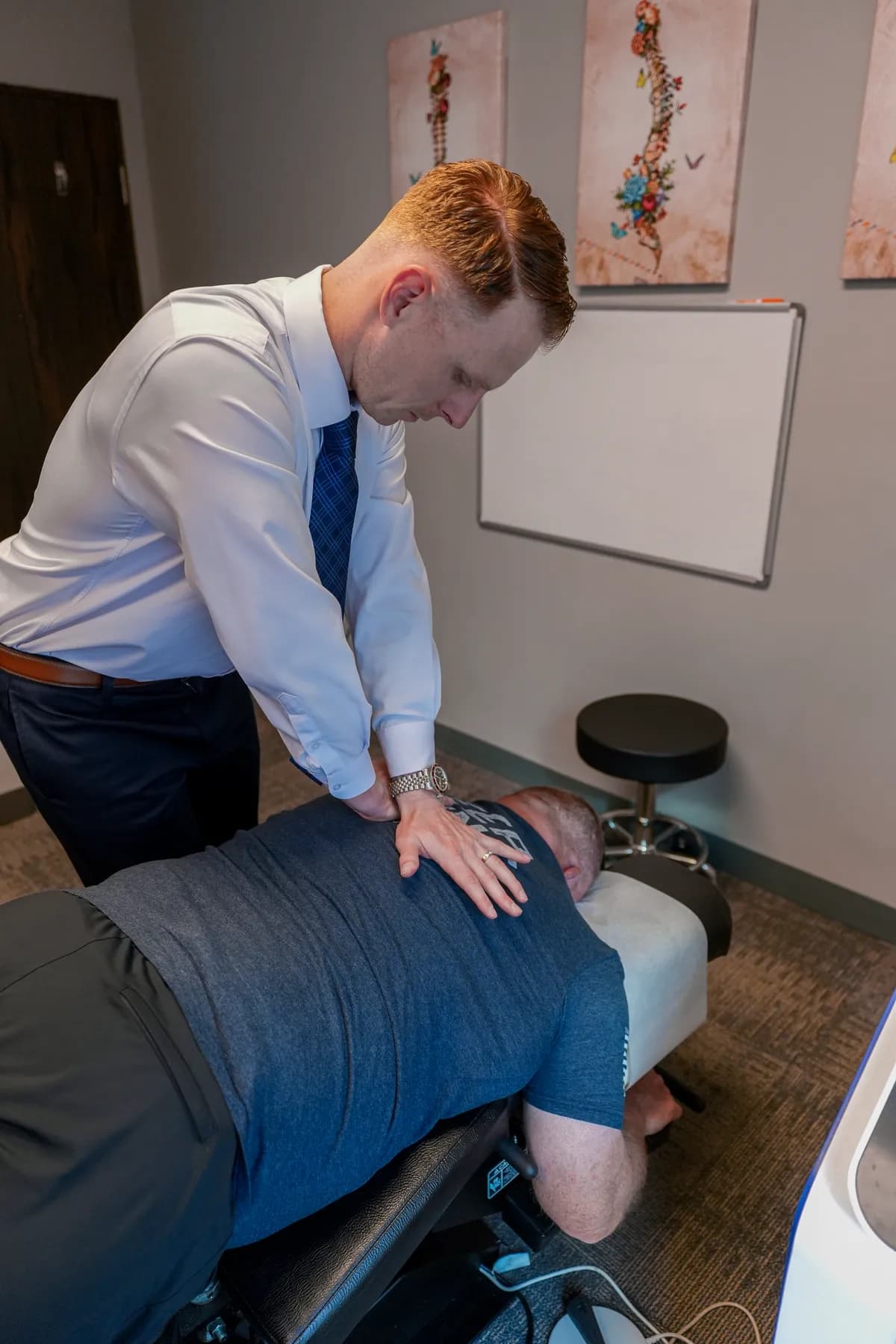
Can chiropractic care help with scoliosis in Downers Grove IL?
Chiropractic care for scoliosis focuses on improving spinal function, managing discomfort, and monitoring how the curve behaves over time. At SpineCo in Downers Grove IL, Dr. Ryan Bielecki, D.C., works with scoliosis patients of all ages to support mobility and quality of life — without overclaiming what conservative care can and cannot do.
Understanding scoliosis: what it is and who it affects
Scoliosis is a lateral curvature of the spine — a sideways bend, often accompanied by rotation of the vertebrae, that produces the characteristic C or S-shaped appearance on a frontal X-ray. A Cobb angle measurement taken from imaging determines the degree of curvature. Scoliosis is most commonly identified in adolescents, particularly during growth spurts, though it can develop in adults as well.
Adult-onset scoliosis is frequently driven by degenerative changes — disc narrowing, joint degeneration, and bone-density changes that cause the spine to shift laterally as it loses its normal architecture. This is a different process from adolescent idiopathic scoliosis, though both produce asymmetric spinal loading and the functional challenges that come with it.
Uneven shoulder or hip height, prominence of one shoulder blade, and observable asymmetry in the rib cage or waist are common first signs noticed by parents or during school screening. Dr. Bielecki evaluates hip and shoulder levelness, leg-length variation, and spinal range of motion as part of scoliosis-related assessment.
What chiropractic care can and cannot do for a spinal curve
It is important to be direct about what conservative chiropractic care offers scoliosis patients. Chiropractic does not straighten a scoliotic curve. The structural changes that produce a lateral curvature are not reversed by spinal manipulation. Anyone suggesting otherwise is overstating the evidence.
What chiropractic care can meaningfully address is the functional burden that scoliosis places on the spine and surrounding musculature. Asymmetric loading accelerates joint wear on one side, creates muscular imbalances and chronic tension, and limits range of motion — particularly rotation. Patients with scoliosis often present with pain patterns that reflect these compensations more than the curve itself.
Targeted spinal adjustments help restore motion to restricted segments, reduce the muscular guarding that builds around immobile or over-loaded joints, and support the best possible movement quality given the structural reality. Many patients with scoliosis report that consistent chiropractic care helps them manage discomfort and maintain the activity levels that matter to them.
Monitoring and the role of periodic reassessment
Scoliosis management involves tracking how the curve behaves over time — particularly in adolescent patients who are still growing. Curves that are small and stable carry a different risk profile than curves that are progressing or that have already reached angles associated with respiratory or cardiac effects.
Dr. Bielecki includes curve monitoring as part of ongoing care for scoliosis patients. Periodic orthopedic evaluation, range-of-motion tracking, and referral for imaging when indicated are all components of responsible long-term management. Patients who are already under the care of an orthopedic surgeon or spine specialist for curve monitoring are welcome to add SpineCo's functional and symptomatic management alongside that oversight.
Large curves or rapidly progressing curves in adolescents may require bracing or surgical consultation — those decisions belong to the orthopaedic team. Dr. Bielecki will communicate clearly when a presentation is outside the scope of chiropractic management and refer appropriately.
Staying active with scoliosis
One of the most common questions Dr. Bielecki hears from scoliosis patients is how much they can still do. The answer, for most people with mild to moderate curves, is a great deal. Avoiding physical activity because of a spinal curve typically makes things worse — the musculature that supports the spine becomes weaker, pain sensitivity tends to increase, and the psychological burden of the diagnosis grows.
The goal at SpineCo is to help patients with scoliosis build a realistic picture of what their spine can handle, identify the movements and loads that are worth modifying, and stay engaged with the activities that support their health and quality of life. The one-on-one model keeps those recommendations tied to the patient's examination, daily demands, and response over time rather than to a generic activity profile.
SpineCo offers 100% one-on-one care — Dr. Bielecki works with you directly at every visit, no assistants or delegation. Book online through Jane App or call (630) 442-0146. The clinic is at 1121 Warren Ave Suite 210, Downers Grove, IL 60515. A focused evaluation can clarify current findings, whether conservative care is appropriate, and when imaging or referral may be needed.
Identify the problem. Build the right plan. Return to what matters.
Schedule an evaluation online, or call the office and talk it through first.
FAQ
Questions, answered.
Can chiropractic care straighten a scoliotic curve?
No — and any provider who claims otherwise is overstating what conservative care can do. Chiropractic does not reverse the structural changes that produce a lateral spinal curve. What it can do is improve function and comfort in a spine that is loading asymmetrically: restoring motion to restricted joints, reducing muscular tension and guarding, and helping patients manage the symptomatic burden of living with a curve.
Is chiropractic care safe for scoliosis patients?
Chiropractic care is generally appropriate for scoliosis patients whose curves are stable and whose symptoms reflect musculoskeletal loading rather than rapid progression or neurological compromise. Dr. Bielecki performs a thorough evaluation at intake, screens for red flags that would change the care approach, and communicates directly with any orthopaedic team that is monitoring the patient's curve.
My child was diagnosed with scoliosis. Can SpineCo help?
Yes. Dr. Bielecki sees younger patients with scoliosis and works to support spinal function, manage any associated discomfort, and monitor how the presentation evolves over time. If a curve requires orthopaedic oversight — particularly for larger or progressing curves in growing adolescents — he will coordinate with that team or provide a referral.
What does back pain from scoliosis actually feel like?
Pain associated with scoliosis typically reflects the musculoskeletal consequences of asymmetric loading — muscle fatigue and tension on the over-recruited side, joint stiffness at compressed segments, and referred patterns from facet joints under asymmetric stress. It tends to be activity-related and positional. Patients often describe discomfort after prolonged sitting, standing, or carrying loads unevenly.
Does scoliosis get worse with age?
Curves that are small and stable in adulthood may remain so. Larger curves — particularly those above 50 degrees — and curves that were still progressing at skeletal maturity carry a higher risk of continued change in adulthood. Degenerative changes in older adults can also produce new lateral curvature or worsen existing ones. Periodic monitoring is the reasonable approach for anyone with a known scoliosis diagnosis.
How do I book a scoliosis evaluation at SpineCo in Downers Grove?
Book online through Jane App or call the clinic at (630) 442-0146. SpineCo is located at 1121 Warren Ave Suite 210, Downers Grove, IL 60515. Monday, Wednesday, and Thursday hours are 9am–6pm; Tuesday 2pm–7pm; Friday 9am–2pm; Saturday and Sunday are closed. The first visit can clarify current findings, whether conservative care is appropriate, and when imaging or referral may be needed.