Conditions · Injuries
Disc Injury
Terms such as disc bulge, protrusion, extrusion, and herniation describe imaging findings. They do not by themselves establish which structure is causing pain, how severe a patient's symptoms should be, or which treatment is appropriate. Disc changes can be present in people without pain, while significant symptoms can occur with findings that appear modest on a report.
At SpineCo, a modern spine and injury practice in Downers Grove, Dr. Ryan Bielecki, D.C., reviews disc findings in clinical context. The history, neurological examination, function, available imaging, and safety screening guide an individualized plan and identify cases that need medical, surgical, or imaging referral before conservative treatment.
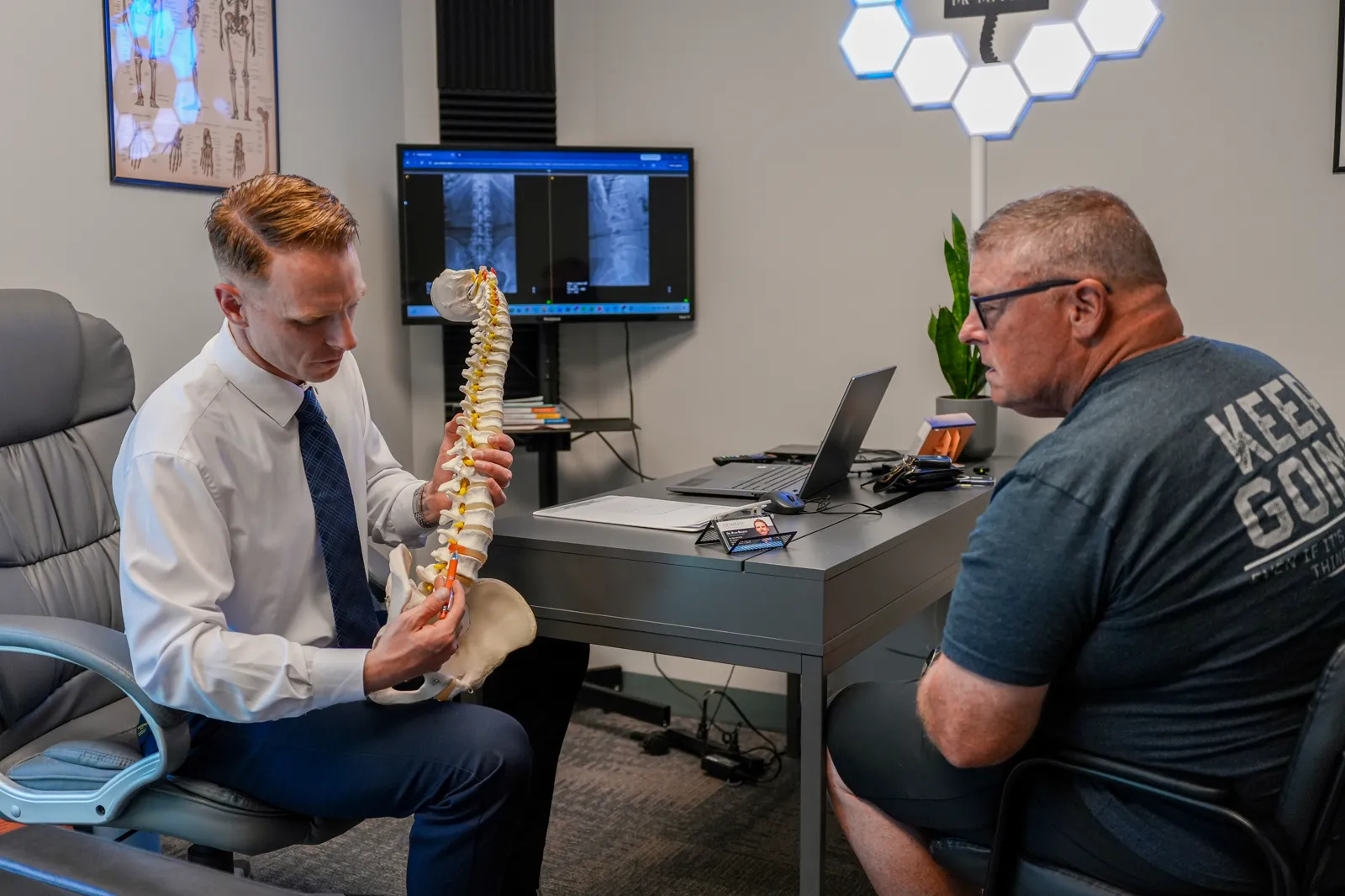
What is the difference between a bulging and herniated disc, and can chiropractic care help in Downers Grove IL?
Disc bulge and disc herniation describe different patterns of disc material seen on imaging, but neither term alone determines symptoms or treatment. At SpineCo in Downers Grove IL, Dr. Ryan Bielecki, D.C., relates imaging to the history, examination, and neurological findings before discussing conservative care, decompression, additional testing, or referral.
What bulging and herniated disc findings mean—and what they do not
A disc bulge generally describes a broad extension of disc tissue beyond its usual boundary. A herniation is a more localized displacement and may be described as a protrusion or extrusion based on its shape. These terms help radiologists communicate anatomy, but they do not grade pain, prove nerve compression, or predict an outcome by themselves.
Clinical relevance depends on whether the imaging location and side agree with the symptom pattern and examination. A disc finding may contribute to local neck or back pain, radiating arm or leg symptoms, numbness, tingling, or weakness, but similar symptoms can also come from joints, peripheral nerves, hips, shoulders, or other medical conditions.
The goal of an evaluation is not to treat an MRI phrase. It is to determine whether the disc finding helps explain the presentation, whether conservative care is safe, and whether progressive neurological findings or another concern call for prompt referral.
Symptoms and examination must be considered together
Dr. Bielecki reviews symptom onset, prior episodes, health history, aggravating and easing factors, and changes in work, sleep, walking, lifting, or other normal activities. The examination may include strength, sensation, reflexes, nerve-tension procedures, spinal and movement assessment, and orthopedic tests chosen for the cervical or lumbar presentation.
Pain with sitting, bending, coughing, or other loading can provide useful clues, but no single response proves a disc source. Likewise, a normal or mild imaging report does not invalidate symptoms. Diagnosis and treatment planning rely on the combined clinical picture.
New bowel or bladder dysfunction, saddle-area numbness, rapidly worsening weakness, major trauma, fever with severe spinal pain, or other sudden neurological changes require urgent medical assessment. Routine conservative care should not delay evaluation of those findings.
Where spinal decompression may fit
Computer-guided spinal decompression is a form of mechanical traction. It may be considered for selected patients with disc-related or radicular symptoms after examination and safety screening, but it is not an automatic treatment for every bulge or herniation and is not a guaranteed way to repair or reposition a disc.
Research on traction is mixed, and clinical guidelines do not support routine use for every person with low back pain, sciatica, or a disc finding. That uncertainty is why SpineCo considers decompression only as a selected adjunct and monitors symptom and functional response instead of promising a fixed outcome or universal number of sessions.
When appropriate, decompression may be one part of a plan that also includes chiropractic or manual care, progressive exercise, education, and activity guidance. If it aggravates symptoms, fails to support the intended goal, or the presentation changes, the plan is modified and referral is considered.
Evaluation and care for disc injuries at SpineCo
Existing imaging is reviewed alongside the history and examination. New imaging is not automatic; it may be appropriate when trauma, red flags, progressive neurological findings, or a question likely to change management is present. A specialist opinion may be recommended even when imaging already exists.
The recommendation can include conservative care, decompression as a selected tool, rehabilitation, self-management guidance, additional testing, or medical or surgical referral. Progress is tracked through neurological findings, symptoms, and meaningful function rather than completion of a predetermined package.
All care is delivered by Dr. Bielecki personally. Book online through Jane App or call (630) 442-0146. SpineCo is at 1121 Warren Ave Suite 210, Downers Grove, IL 60515.
Identify the problem. Build the right plan. Return to what matters.
Schedule an evaluation online, or call the office and talk it through first.
FAQ
Questions, answered.
Can a bulging or herniated disc heal on its own?
Symptoms from a disc-related presentation can improve over time, and some herniated disc material may decrease on later imaging. A scan does not have to look normal for function to improve, and no conservative treatment can guarantee structural healing. Management depends on symptoms, neurological findings, function, safety concerns, and progress over time.
Does a disc injury always show up on an MRI?
MRI can show discs and nearby neural structures in detail, but imaging findings do not always correlate with symptoms. New MRI is not routinely required for every episode. It is considered when the result is likely to change management, when serious or progressive findings are present, or when a specialist needs it for further decision-making.
What activities should I avoid with a disc injury?
Broad restrictions based only on an imaging label can be unnecessarily limiting. Activities that sharply worsen radiating symptoms or neurological signs may need short-term modification, while tolerable movement and progressive activity are often part of conservative management. Dr. Bielecki gives specific guidance from the examination, daily demands, and response rather than prescribing the same restrictions to everyone.
Is spinal decompression the same as traction?
Spinal decompression is a form of mechanical traction delivered with a computer-guided table. Different devices can vary force and positioning, but the name does not establish that treatment will create a particular disc change or outcome. SpineCo considers it only after an evaluation and monitors whether it supports the patient's clinical and functional goals.
How is a disc injury different from a pinched nerve?
A disc injury describes a structural finding or diagnosis involving an intervertebral disc. A 'pinched nerve' is an informal description for nerve irritation or compression, which can have disc-related and non-disc causes. The examination and, when indicated, imaging help determine whether a disc finding and a nerve symptom pattern are actually related.
How do I book a disc injury evaluation in Downers Grove?
Call SpineCo at (630) 442-0146 or book online through Jane App. The clinic is at 1121 Warren Ave Suite 210, Downers Grove, IL 60515. Hours are Monday, Wednesday, and Thursday 9am–6pm; Tuesday 2pm–7pm; Friday 9am–2pm; Saturday and Sunday closed.
Clinical references