Conditions · Extremities
Foot Pain
The foot is the first thing that meets the ground — every step, every rep, every mile. Thirty-three joints, twenty-six bones, and over a hundred muscles and ligaments work together to absorb load, propel movement, and adapt to uneven terrain. When that system is compromised, the consequences travel upward: altered gait shifts stress to the knee, hip, and low back, turning what started as foot pain into a full-chain problem.
At SpineCo: Chiropractic & Performance in Downers Grove IL, Dr. Ryan Bielecki, D.C. treats foot pain with the same foundation-first logic. How force is distributed across the plantar surface, how the ankle moves, and how gait has adapted around pain all inform what the most effective intervention will be. 100% one-on-one care means every assessment and treatment is personal — the same doctor, every visit.
Can a chiropractor help with foot pain or plantar fasciitis in Downers Grove IL?
Yes. Dr. Ryan Bielecki, D.C. at SpineCo in Downers Grove IL assesses foot pain through a full mechanical lens — plantar loading, gait patterns, and how the foot interfaces with the ankle, knee, and hip. For persistent plantar heel pain and soft-tissue injuries, shockwave therapy is also available at the clinic.
Plantar mechanics: what is actually happening underfoot
Plantar fasciitis — inflammation of the thick band of connective tissue running along the sole — is the most common cause of heel pain, particularly in runners, athletes, and people who spend long hours on their feet. It typically announces itself as sharp heel pain with the first steps of the morning or after extended sitting. The mechanism is straightforward: repetitive tensile loading of the plantar fascia exceeds the tissue's capacity to recover.
What determines that capacity is not just how much someone runs or stands — it is the quality of the load. Collapsed arches, excessive pronation, and limited ankle dorsiflexion all change how force distributes across the plantar surface with each step. A rigid first metatarsophalangeal joint (the joint at the base of the big toe) creates a mechanical ripple that increases fascial tension throughout the stance phase of gait.
At SpineCo, assessment of plantar pain goes beyond pressing on the heel. Dr. Bielecki evaluates foot posture, ankle mobility, gait pattern, and joint mechanics of the forefoot and midfoot to identify which structural factors are sustaining the load problem — not just where it is painful.
Gait and load: what runners, athletes, and on-your-feet workers share
Athletes who run, cut, and jump, and workers who stand on hard surfaces for eight-hour shifts are both asking the same tissue to absorb extraordinary cumulative load. The difference is the direction. Athletes often stress the foot asymmetrically — push-off patterns in throwing sports, the lateral cuts of court sports, the repeated single-leg impact of distance running. Workers tend to accumulate more bilateral, slow-onset fascial fatigue.
Both populations benefit from a gait analysis that identifies how force is landing and where compensations have developed. A stiff midfoot, a dropped arch on one side, or a hip that refuses to extend fully at push-off all redirect stress somewhere else. The foot is usually the receiving end of problems that start higher in the kinetic chain.
Dr. Bielecki's background training five to six days per week himself gives him direct context for what reasonable loading looks like versus what accumulates into injury. That perspective shapes how activity modification is discussed — the goal is never simply to rest, but to load smarter while the tissue recovers.
Where shockwave therapy fits for stubborn foot pain
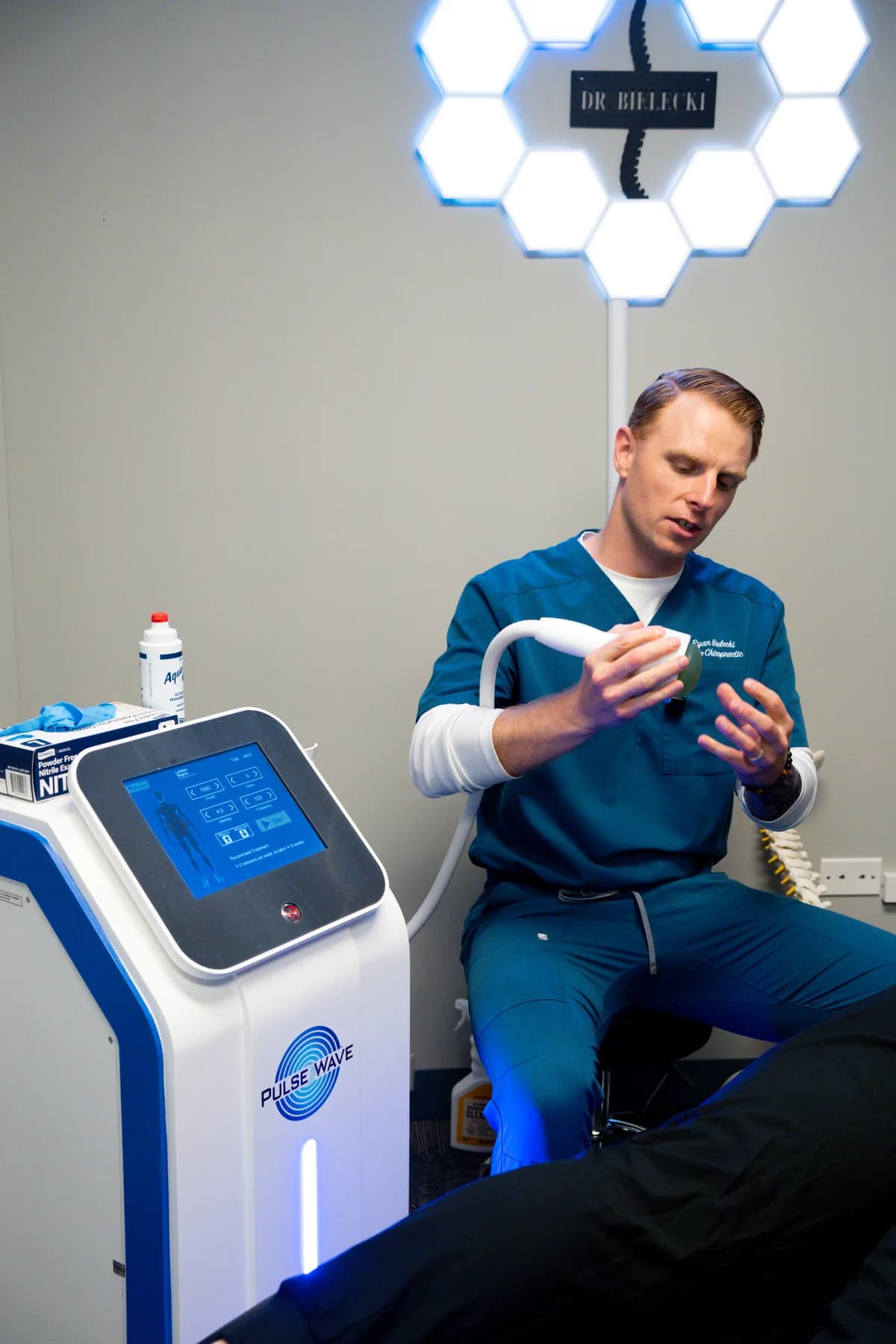
Plantar fasciitis that has persisted for several months despite rest, stretching, and standard conservative care is a strong candidate for shockwave therapy. Shockwave — extracorporeal shockwave therapy (ESWT) — delivers acoustic pressure waves to the targeted tissue, stimulating a localized healing response in chronically irritated tendons and fascial insertions that have essentially stalled out.
SpineCo offers shockwave therapy as part of the broader treatment toolkit for persistent plantar heel pain and other lower-extremity soft-tissue conditions. The evidence base for ESWT in plantar fasciitis is well-established, and the treatment integrates directly with the mechanical work that addresses why the tissue was overloaded in the first place.
Shockwave alone does not change the biomechanics that drove the problem. At SpineCo, it is paired with joint work, gait correction, and rehab guidance so that the tissue can recover into a better mechanical environment rather than back into the same pattern that stressed it initially.
Forefoot and toe pain: a different region, different drivers
Heel pain is common, but plenty of foot problems originate further forward. Metatarsalgia — pain across the ball of the foot — develops when weight distribution shifts too heavily onto the metatarsal heads, often due to high-heeled footwear, a tight Achilles that limits dorsiflexion, or structural changes to the forefoot arch. The sesamoid bones beneath the first metatarsal can also become irritated in athletes who spend significant time on the balls of their feet.
Toe problems from poorly fitting footwear sit at a different end of the foot, and bunion formation reflects years of mechanical stress redirecting the first ray medially. None of these presentations are separate from gait — they are gait problems localized to a particular region.
SpineCo's evaluation covers the whole foot, not just the loudest symptom. Knowing whether pain is coming from the heel, midfoot, forefoot, or a combination determines how the care plan is built and which interventions — adjustment, soft-tissue work, shockwave, or rehab cuing — will address the actual drivers.
Getting assessed for foot pain in Downers Grove IL
People who have been managing foot pain with stretching, orthotics, or NSAIDs often find that the relief is partial and temporary because the mechanical conditions driving the problem are still present. A clinical evaluation at SpineCo creates a clearer picture: which structures are involved, how gait has adapted, and whether a regional or whole-chain approach is most appropriate.
Dr. Bielecki's foot pain assessment integrates with the broader musculoskeletal evaluation SpineCo performs. Foot symptoms that have changed how someone walks for weeks or months often show upstream effects at the knee and hip — catching those secondary adaptations early is part of the work.
A focused evaluation can clarify what may be contributing to your symptoms, whether conservative care is appropriate, and when imaging or referral may be needed. Book online through Jane App or call (630) 442-0146 to schedule at SpineCo, 1121 Warren Ave Suite 210, Downers Grove, IL 60515.
Identify the problem. Build the right plan. Return to what matters.
Schedule an evaluation online, or call the office and talk it through first.
FAQ
Questions, answered.
What causes plantar fasciitis and how does a chiropractor treat it?
Plantar fasciitis is caused by repetitive tensile stress on the plantar fascia — the tissue running along the sole from heel to toes. Biomechanical factors like limited ankle mobility, arch collapse, and gait asymmetries drive the overload. Dr. Bielecki at SpineCo in Downers Grove IL addresses both the local tissue and the mechanics that caused the strain, including shockwave therapy for persistent cases.
How does foot pain affect the rest of my body?
When the foot hurts, gait changes automatically. The altered loading pattern shifts stress onto the ankle, knee, hip, and low back, often producing secondary problems in those regions over time. SpineCo evaluates the full kinetic chain to identify where compensations have developed — not just the site of foot pain — so treatment addresses the full picture.
What is shockwave therapy and does SpineCo offer it for foot pain?
Shockwave therapy (ESWT) delivers acoustic pressure waves to chronically irritated soft tissue — plantar fascia insertions, Achilles tendons — to stimulate a healing response. It is well-supported for plantar fasciitis that has not responded to standard conservative care. SpineCo offers shockwave as part of its foot pain treatment options, paired with mechanical correction to address the underlying cause.
Can foot problems cause knee pain or hip pain?
Yes. Altered foot mechanics change how force travels through the leg on every step. Overpronation, reduced arch support, or restricted ankle mobility can increase rotational stress at the knee and compressive load at the hip over time. Addressing the foot mechanics often supports better outcomes for knee and hip complaints that developed secondarily.
How long does foot pain typically take to improve with chiropractic care?
Response varies by how long symptoms have been present and what is driving them. Acute plantar heel pain that is caught early often responds within a few weeks of consistent care and mechanical correction. Chronic cases — pain present for months without structural changes being addressed — typically take longer and may benefit from shockwave therapy alongside chiropractic treatment. Dr. Bielecki outlines a realistic timeline at the first visit.
How do I book a foot pain evaluation at SpineCo in Downers Grove IL?
Schedule online through Jane App at any time or call (630) 442-0146 during office hours. SpineCo is at 1121 Warren Ave Suite 210, Downers Grove, IL 60515. Hours are Mon/Wed/Thu 9 a.m.–6 p.m., Tue 2 p.m.–7 p.m., Fri 9 a.m.–2 p.m., and Sat/Sun closed.